FAQs
1.1 What is Hindu Fund's mission?
Hindu Fund (under Hindu Network Foundation) is building a ₹1,000 Crore grants corpus to support dharmic change-makers across India, under the principle “Trust by Default & Evaluate Over Time” — liberal grant-making paired with long-term accountability.
Three strategic pillars:
● Preserve & Protect — heritage (e.g., Manuscripts & Inscriptions)
● Defend & Thwart — legal and intellectual strategies (e.g., Legal Fund)
● Promote & Expand — expansionary strategies for Hindu Dharmic values (e.g., Gharwapsi, Spiritual Infrastructure)
1.2 Who is a "Hindu" in the context of Hindu Fund? Are Sikhs, Jains, and Buddhists included or excluded?
Hindu Fund treats “Hindu” as an umbrella term for all Indic-origin traditions, in line with the Supreme Court of India’s broad, civilizational reading of the term:
- Sikhism, Jainism, Buddhism, and India’s tribal traditions are treated as panths (paths) within this wider Indic family — not excluded, separate faiths.
- The line the Fund draws is theological, not institutional: none of these traditions is exclusivist — none conditions salvation or damnation on one belief system. This contrasts with Islam and Christianity, which the Fund views as structured around exclusivist theology.
“You are a Muslim, hence I am a Hindu; else I am a global human.”
— Veer Savarkar
1.3 What problem is Hindu Fund solving, and why does it matter?
Hindu philanthropy tends toward emotional, short-term causes, while civilizational change needs sustained, strategic funding. Hindu Fund closes that gap — multi-year grants across Preserve–Defend–Expand, shifting giving from reactive to institution-building.
For a forceful take on the stakes, see this talk by Swami Dayananda Saraswati: youtube.com/watch?v=tG5N-iUUiWs — an illustrative parable arguing India’s constitutional framework leaves the Hindu majority under-protected.
1.4 Is there evidence that Hindu philanthropy is less strategic than other communities' giving?
Yes — two data points.
- US academic influence. Endowed university chairs, compared across communities:
Field | Chairs / Institutes in US | Investment | Funder |
|---|---|---|---|
Hindu Studies | ~4–8 (first true chair only in 2018, USC; UC Irvine’s 2015 batch saw 2 of 4 later rejected amid controversy) | ~$10–15M | Indian-American donors, Dharma Civilization Foundation |
Jain Studies | 2–3 | ~$3–4M | Jain-American community |
Sikh Studies | 2–3 | ~$3–5M | Sikh-American community |
Chinese Studies | ~100 Confucius Institutes at 2017 peak, <5 remain | $158M (2006–19) | Government of China |
Islamic/Middle Eastern Studies | Hundreds of chairs, dozens of centers | $8.5–15B+ since 1976 | Gulf governments |
Hindu-American giving has gone mostly to temples, gaushalas, and gurukulas — valuable, but largely absent from the academic spaces where public narratives about Hindu civilization get shaped. That’s the gap Hindu Fund targets.
- India’s own CSR spending tells a similar story:
CSR Category | Amount | Period |
|---|---|---|
Total CSR spend | ₹34,909 Cr | FY24 (record) |
Education | ~₹12,000 Cr (35%) | FY24 |
Healthcare | ~₹7,000 Cr (20%) | FY24 |
Art & Culture | ~₹2,840 Cr (+144% growth) | FY20–24, 5-yr cumulative |
Even after strong growth, Art & Culture’s 5-year total is a fraction of Education or Healthcare’s single-year spend. And within that small slice, companies favor visible one-off events and festivals over sustained heritage or institution-building work — the kind Hindu Fund’s grantees take on — because the latter is slower and less photogenic.
1.5 What types of projects and themes does Hindu Fund make grants on?
Ayurveda · Building Spiritual Infrastructure · Dharma in Academics · Economic Reform · Indian Knowledge Systems · Interfaith Harmony · Legal Activism · Retelling History · Social Media & Narratives · Social Upliftment
Full filterable grant list by category/year: hindu.fund/our-work
1.6 Why such a broad range of activities — is there really a focus?
Hindu Fund is a pure grant-making body — it doesn’t run its own projects (aside from limited direct legal work). That’s what lets it fund a wide range of aligned initiatives without being boxed into one issue.
1.7 I already donate a lot to Gaushalas, Gurukulas, and Matthas — why should I get associated with Hindu Fund?
Such giving is clearly valuable and doesn’t need to be redirected — Gaushalas, Gurukulas, and Matthas meet real needs. Hindu Fund complements it by covering what traditional religious philanthropy usually doesn’t:
- Legal defence of dharmic institutions and individuals
- Media and narrative-building (in line with the Swayambodh–Shatrubodh framework, below)
- Manuscripts and Inscriptions — digitisation before they’re lost
- Constitutional and legal battles
- Research and funding on topics like Reincarnation, Indian Knowledge Systems (IKS), and other under-explored areas
- Addressing the challenges of demographic change
Think of it as portfolio diversification: sustain tradition on one hand, fund harder, strategic work on the other.
Some of that harder work is also deliberately uncomfortable: multi-year legal cases, Love Jihad prevention, and Gharwapsi don’t offer the same feel-good, visible payoff as building a temple — and they can invite controversy many donors avoid. Avoiding a cause because it’s contentious is still a choice, with consequences.
This is where the Swayambodh–Shatrubodh framework (Hindu thinker Pankaj Saxena) is useful: Swayambodh is self-knowledge — one’s own civilizational roots; Shatrubodh is knowledge of the adversary — clarity on the ideologies (not individuals) that have historically worked to convert or erode that identity. Temples and gurukulas build Swayambodh. Legal defence, anti-conversion work, and Gharwapsi are Shatrubodh in practice. A healthy civilization needs both.
“Tolerance of intolerance is cowardice.”
— Ayaan Hirsi Ali
1.8 Is Hindu Fund affiliated with the RSS?
No formal affiliation. RSS-affiliated individuals sometimes collaborate voluntarily; there’s no institutional link.
2. Priorities & Key Grantees.
2.1 Are there any priority areas?
Yes — four, each with a ₹25 Crore target corpus:
Area | Pillar | Description |
|---|---|---|
Legal Fund | Defend | FIRs, RTIs, temple reclamation litigation |
Manuscripts & Inscriptions (MIDF) | Preserve | Scanning, Unicode encoding, digital platforms |
Gharwapsi (SGF) | Expand | Reconversion support |
Spiritual Infrastructure | Expand | Gurukulas, ashrams, temple rebuilding |
2.2 What does "Building Spiritual Infrastructure" entail?
Grantee | Project | Grants Given | Impact |
|---|---|---|---|
Vaidika Bharata (Āngirasa Antarvediya Gurukulam, founded by Mohit Bharadwaj) | Gurukula-Goshala campus construction & Vedic manuscript digitisation, Banswara, Rajasthan | ₹1.76 Cr+ — lifetime | Revived 2 of 3 critically endangered Rigveda shakhas, incl. the near-extinct Shankhayana Shakha; built a second 5+ acre Gurukula-Goshala campus (Bos indicus goshala); digitised 43,000+ pages of rare manuscripts; residential Vedic summer camps grown from ~20 to 75+ students |
Sanatan Siddhashram (Baul Ashram) — Ekathara Kalari / Ma Parvathy Baul | Student Residential Campus construction, Golpur, West Bengal (plus earlier Ekathara Kalari operational support) | ₹1.63 Cr+ — lifetime (₹25.8L FY22–23, ₹22L FY23–24, ₹56L FY24–25, ₹59.6L FY25–26, ₹1.8L FY26–27 to date) | Built ashram/Gurukul near Shantiniketan (Sanatan Shabha Ghar, Mahakala Bhairava Temple, Naga Shrine); Student Residential Campus now 44% funded; Subarna Balya Hriday children’s programme now serving ~40 village children |
UgraNarasimha Charitable Trust — #ReclaimTemples | Temple restoration & documentation, North Kerala (Mahabharath project: 108 additional temples targeted pan-India) | ₹53 lakh+ — FY22–23 to FY25–26, documented | 6 of 17 tracked temples fully restored & handed over to devotee committees; 160 of 300 destroyed Kerala temples documented; revived the Maghamaka Mahotsava (halted since 1766); active litigation on 2 encroachment cases |
2.3 What is the "Legal Fund"?
The Legal Fund is one of Hindu Fund’s four priority areas, under the Defend pillar — supporting constitutional challenges, strategic litigation, and everyday tactical legal matters (FIRs, RTIs, temple reclamation) on issues concerning Hindu civilisation. It remains an internal endowment fund for now, rather than a separate SPV like MIDF or SGF (see Section 4).
2.4 The laws of India seem biased against Hindus. Will the Legal Fund take up lobbying, given that Hindu Fund is Delhi-based?
Yes — Hindu Fund sees this as a significant constitutional problem, and the Legal Fund exists to fund lawyers fighting it at three levels: constitutional challenges, strategic litigation, and everyday tactical matters.
Structure: Currently an internal group, not yet a separate entity (see Section 4). Plan: spin off as an SPV with seed funding once leadership is identified.
Current work, in three parts:
- Temple reclamation & heritage litigation, mainly via the Chambers of Advocate Vishnu Shankar Jain and Hari Shankar Jain. Active: Kashi Vishwanath (Gyanvapi), Krishna Janmabhoomi (Mathura), Bhojshala (Dhar), Sambhal (Hari Har Temple), Karnataka’s temple-endowments law, Mawjymbuin Cave (Meghalaya), Bijamandal (Vidisha). Upcoming: Taj Mahal, Qutub Complex, Adhai-Din-Ka-Jhonpra (Ajmer), two further Varanasi sites. The Chambers also defend Hindu activists facing what Hindu Fund views as retaliatory prosecution, and are building a “Legal Gurukul” office in Noida for full-time litigation work.
- A wider network of independent lawyers — Mumbai, Chandigarh, Delhi, Deoghar, Madhya Pradesh, and Jaipur, among other locations. Most work voluntarily today with partial Hindu Fund support; goal is formal retainerships for ongoing, professional case handling.
- RTIs, complaints, and policy representations — 214 RTIs and 6+ formal complaints filed to date (ASI monument policy, airport prayer facilities, illegal religious structures in Delhi, Waqf Board audits, and more), plus 18 further matters in progress or planned (anti-conversion law reform, a “Shuddhi” reconversion certification mechanism, a Transfer of Property Act challenge on Hindu gift deeds vs. Muslim Hiba, and others).
2.5 What is MIDF?
MIDF (Manuscripts and Inscriptions Digitization Foundation) is a special-purpose vehicle incubated by Hindu Fund to build a comprehensive digitisation platform for India’s manuscripts and inscriptions — a gap no existing Indian organisation was filling. Co-founded by Rahul Dewan, Shreyas Bharadwaj, Sudarshan HS, and Narayana Bhatta. (midf.org.in, smriti.midf.org.in) See Section 4 for more on its structure.
- Protection from digital colonisation — ensuring India’s manuscripts and inscriptions are digitised, hosted, and controlled by Indian institutions themselves, rather than becoming dependent on foreign platforms, archives, or AI systems trained on this heritage without Indian ownership or consent.
2.6 Manuscript digitisation is also being done by other organisations and government agencies — is MIDF coordinating with them to avoid costly duplication?
Yes. MIDF stays in regular contact with the Gyan Bharatam Mission to avoid duplicating work already underway. Beyond that, MIDF intends to position itself as a Project Management Unit (PMU) for the Ministry of Culture — an expert advisory body helping guide the Gyan Bharatam project itself, not just working alongside it.
2.7 What is SGF?
SGF (Sanatana Gharwapsi Foundation) is a special-purpose vehicle incubated by Hindu Fund to give the Gharwapsi mission dedicated, focused ownership — one of the four priority areas under the Expand pillar. See Section 4 for its structure, and below for its approach and rationale.
2.8 Why is Gharwapsi a funding priority, how does it work in practice, and why does it focus on Muslim communities rather than equally on Christian conversion in South India?
- Why it matters: Hindu total fertility rate has fallen below replacement level (1.9), a demographic concern paired with ongoing conversion activity by other groups; historically, many Hindus left the faith under force, inducement, or social pressure, and Gharwapsi offers a voluntary, dignified route back — a counterweight to well-funded missionary activity (citing FCRA inflows to Christian organisations) and an exercise of the constitutional right to religious freedom (Sant-Samaj appeals, Gotra Daan for caste integration, legal name-change support).
- How it works: SGF doesn’t run Gharwapsi activities itself, but works through two channels — the Sant Samaj and Hindu Jaati organisations — to shift national consciousness from a defensive posture to a confident one, engaging Muslim communities on voluntary return via original jaati, Gotra Daan where lineage is lost, or movements like ISKCON, Arya Samaj, Isha Foundation, and the Art of Living. This distinguishes SGF from other groups nationally that make exaggerated claims of reach.
- Why the near-term Muslim focus: Hindu Fund’s mandate covers all issues concerning Hindu civilisation, not Islam specifically — Punjab’s Christianity problem is addressed directly in Hindu Fund’s own presentations. Strategically, SGF expects Christian conversion to be addressed indirectly: once Hindu society builds the confidence to assert its own values rather than only defending against one adversary, that energy naturally extends to Christian conversion too — alongside a direct “tit-for-tat” (game theory) approach of matching missionary energy with active Hindu outreach and revival work.
- Philosophically, Advaita Vedanta’s non-dual framework treats all existence as one underlying reality rather than sorting people into believer/infidel — a more integrative, humanist starting point than exclusivist theology. On this basis, Hindu Fund expects a confident, assertive Hindu dharma to outcompete missionary activity over time — not by imitating it, but by offering something more coherent.
2.9 You hold the view that Hinduism has to be expansionist and do as the Christians do — proselytise. Why fall to their level?
Hindu Fund’s view draws on an essay by Sanjeev Sanyal (Member, Economic Advisory Council to the PM), “The Architecture of Hinduism”:
- Hinduism behaves like a complex, adaptive system (more language or ecosystem than fixed doctrine) — such systems have no stable equilibrium; they’re always expanding or contracting.
- Purely defensive measures (e.g., anti-conversion laws) treat a shrinking system as if it can just be held in place. A community in decline needs expansionary strategies — intellectual/cultural innovation, social outreach, alliances — to “re-inflate,” not just defend.
- Expansion here isn’t imitation for its own sake — it’s applying the same renewal logic that’s kept Hinduism adaptive throughout history.
2.10 Could you share some other key projects with high impact across your categories?
Yes — a few illustrative examples of grantee impact across categories, beyond those covered elsewhere in this document:
Grantee | Project | Grants Given | Impact |
|---|---|---|---|
Bodha (research think-tank) | Field research on North-East India, for a book on cultural change | Not publicly specified | Two field trips (Tripura, Nagaland, Arunachal Pradesh, Meghalaya, Assam) — 65 villages, 65 interviews, 15 tribes. Documents indigenous religious practices, Christian conversion dynamics, and emerging Gharwapsi trends |
Gavishti Foundation (Rahul Roushan & Nupur J. Sharma) | Hinduphobia Tracker | ₹22.8 lakh — fully utilised | Verified database of religiously motivated hate crimes against Hindus, with journalistic-grade evidence standards (FIRs, news reports, video). 2,000+ verified cases, ~10,000 victims recorded |
FACT (founded 2003, François Gautier) | Durgavati Hall, Chhatrapati Shivaji Maharaj Museum, Pune | ₹18 lakh (2025–26) | Documents terrorism-linked human rights abuses and overlooked civilisational history. Museum drew 15,000+ visitors in 2024–25 |
Sewa Nyaya Utthan Foundation (Swati Goel Sharma & Sanjeev Newar) | Project SANKALP, Bhopal | ₹22.01 lakh of ₹25 lakh requested | Ragging-free, communally safe campuses in Bhopal. Foundation separately runs refugee-child education and riot-victim rehabilitation |
3. History & Org Design
3.1 Hindu Network Foundation was formed in 2024 — why does the website reference activity since 2016?
The legal entity (a Section 8 company with 12A & 80G registration) was formed in 2024, but the lineage goes back further:
- Sarayu Foundation Trust (founded 2006 by Rahul Dewan and Col. Ramakrishnan) began third-party grants to dharmic organisations in 2016.
- These grants were retrospectively attributed to Hindu Fund at launch, separating them from Sarayu’s own internal projects.
- Rahul Dewan founded and is the largest donor to both — so the attribution reflects one continuous mission.
3.2 So what exactly is the relationship between Sarayu Foundation and Hindu Fund?
Sarayu (2006) is the parent lineage. Its third-party grants since 2016 are now attributed to Hindu Fund; Sarayu still runs its own internal projects independently. Hindu Fund, under Hindu Network Foundation, is the vehicle for large-scale external grant-making going forward.

Sarayu’s internal projects and third-party funding structure
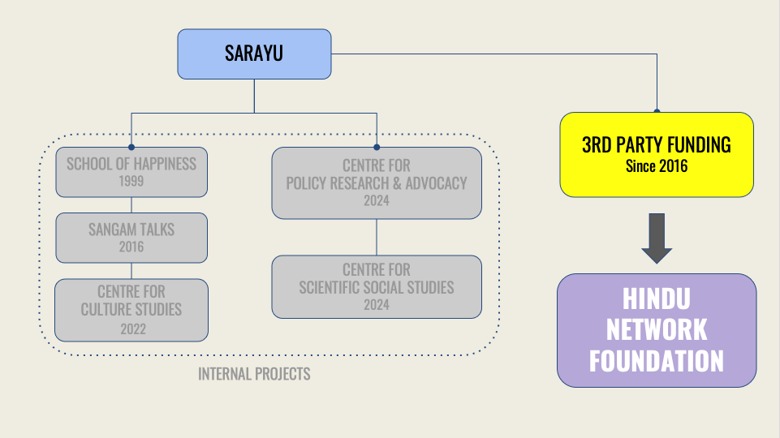
Third-party funding flowing into Hindu Network Foundation
3.3 Does this mean Sarayu's internal projects (e.g., Sangam Talks) are funded by Hindu Fund?
No. School of Happiness, Sangam Talks, and the Centres for Culture Studies, Policy Research & Advocacy, and Scientific Social Studies are funded separately and directly by Rahul Dewan — not by Hindu Fund grants.
4. Leadership & Grant-Making Philosophy
4.1 Who is Rahul Dewan?
Tech entrepreneur, angel investor, and yoga/meditation practitioner. Sold his software business to a US company; now invests in India/Israel startups (CleanTech, Ayurveda, HealthTech, Defence). Founded Sarayu Foundation Trust (2006); Sangam Talks, its flagship project, is described as the world’s largest YouTube channel on Indian Knowledge Systems. Follower of Sadhguru Jaggi Vasudev; writes at medium.com/doing-the-right-things. Current focus: raising the ₹1,000 Cr Hindu Fund corpus, with initial priority on ₹50 Cr across Legal, Spiritual Infrastructure, Manuscripts & Inscriptions, and Ayurveda.
4.2 How much has Rahul Dewan donated towards third-party funds since 2016? Does he have skin in the game? What if he is misusing the funds collected?
- Skin in the game: He’s personally contributed ₹19 Cr towards third-party grants — first via Sarayu Foundation Trust, and since Hindu Fund’s launch, via Hindu Fund itself — from personal funds and a self-imposed “7% rule” (7% of his former business’s profits). As noted in Section 3, Sarayu’s third-party grants are attributed to Hindu Fund, so this reflects one continuous contribution; he’s been the largest donor from the start.
- Accountability: Governance sits with the Board of Directors and Governing Council, not Dewan alone. Finances are statutorily audited (12A, 80G, CSR registrations). Public audits, grantee-wise disbursement records, and the ability for anyone to contact grantees directly are designed to guard against misuse.
For his personal motivations: youtube.com/watch?v=6AF-m4RwT0c, youtube.com/watch?v=AmfO00fOwFg
4.3 Where is Rahul Dewan's primary attention now — Sarayu, Hindu Fund, or MIDF?
- Hindu Fund is his primary focus today.
- Sarayu and its internal projects run largely in auto-mode under their own leaders; he reviews quarterly. Exception: Sangam Talks, where he stays closely involved in strategy.
- MIDF and SGF are SPVs incubated by Hindu Fund, not projects he runs directly — each has its own head/Chairperson, even though he remains associated with them.
4.4 Rahul Dewan seems to be associated with both MIDF and SGF. What is the relationship between these organisations and Hindu Fund?
Lorem ipsum dolor sit amet, consectetur
MIDF and SGF are special-purpose vehicles (SPVs) incubated by Hindu Fund — each seeded with grants to give a high-priority mission dedicated, focused execution rather than being one line item among many.
- MIDF (Manuscripts and Inscriptions Digitization Foundation) — co-founded by Rahul Dewan, Shreyas Bharadwaj, Sudarshan HS, and Narayana Bhatta, to fill a gap: no existing Indian body was building a comprehensive digitisation platform. Long-term vision: independent operation. (midf.org.in, smriti.midf.org.in)
- SGF (Sanatana Gharwapsi Foundation) — similarly incubated to give Gharwapsi dedicated ownership; one of the four priority areas under Expand.
Legal Fund, the fourth priority area, isn’t structured this way yet — it’s currently an internal endowment fund, not an SPV. Hindu Fund is considering incubating one, following the MIDF/SGF model, once suitable leadership is identified.
elit. Ut elit tellus, luctus nec ullamcorper mattis, pulvinar dapibus leo.
4.5 Hindu Fund seems to be Delhi-based, and hence does grant donations have a North-Indian skew?
No. Grants span states across every region — plus an international footprint (Belgium, Bangladesh, Sri Lanka). Live breakdown: hindu.fund/our-work
Lifetime grants by state, to date:
State / Category | Lifetime Grants |
|---|---|
PAN India Outreach | 67 |
Delhi NCR (Registered) | 35 |
Tamil Nadu | 27 |
Madhya Pradesh | 22 |
West Bengal | 21 |
Karnataka | 20 |
Kerala | 18 |
Uttar Pradesh | 18 |
Haryana | 13 |
Maharashtra | 13 |
Punjab | 8 |
Gujarat | 6 |
Jharkhand | 6 |
Telangana | 6 |
Jammu & Kashmir | 2 |
Rajasthan | 2 |
Andhra Pradesh | 1 |
Bihar | 1 |
Delhi’s own count reflects grants registered through Hindu Fund’s Delhi office, not necessarily grants deployed in Delhi — many of these serve causes elsewhere. Notably, “PAN India Outreach” (67) is the single largest category, larger than any individual state, underlining that the bulk of Hindu Fund’s reach is national rather than regionally concentrated.
4.6 Why "liberal" grants — what does "Trust by Default & Evaluate Over Time" mean in practice?
Start from trust, not suspicion — due diligence still happens (reviewing past work, asking direct questions), but grants run 2–3 years rather than demanding instant results. Goal: less bureaucracy for grantees, accountability through ongoing evaluation rather than upfront gatekeeping.
4.7 What sort of due diligence do we do?
The process of grant applications is not much different from fundraising pitches. Further, we have conversations with the individuals, try and evaluate their skin in the game, their passion, etc.; visits to their project sites, if applicable, are made.
4.8 How are grantee organisations selected?
- Grantees typically send in proposals; references from within the dharmic network help establish trust.
- Strategic and long-term impact is evaluated.
- Hindu Fund currently steers away from Indian Knowledge Systems (IKS) requests — many other organisations already cover that space.
- For the individual proposing a project: their background and commitment (career sacrifices made, time invested, communication skills, how they handle tough questions) — much like an angel-investment pitch, for Dharmic projects.
5. Transparency and Donor Engagement
5.1 Who controls the Fund, and who decides on grant allocations?
- Formally: the Board of Directors and Governing Council — Rahul Dewan (Chair), Anand Prasad, Vijaya Vishwanathan, Col. Ramakrishnan, and others.
- In practice, today: Governing Council member Sudarshan HS (also part of MIDF’s founding team) reviews and approves proposals related to Manuscripts and Veda Pathshalas, while Dr. Rinkoo Wadhera (head of Sarayu’s Centre for Culture Studies) approves proposals on Indian Knowledge Systems (IKS). The goal is to gradually expand this into a broader committee model — Governing Council members plus external specialists — alongside a planned Advisory Board of large donors.
- All grants, present and future, go through review under the “Trust by Default” framework.
5.2 Is there public transparency into how funds are used?
Yes. Published at hindu.fund/resources: CSR certificate, PAN card, 12A & 80G certificates, audit reports, monthly impact reports.
The complete, year-wise grantee and disbursement list is at hindu.fund/our-work — anyone can contact grantees directly to verify what they received.
5.3 How much of the ₹1,000 Crore goal has actually been raised so far?
Very little. ₹1,000 Cr is a long-term corpus target (intended to generate sustainable annual returns), not current holdings. Today’s working balance is small (~₹25–30 lakh at any time), since contributions get deployed immediately against commitments rather than banked. Building an actual corpus, instead of funding hand-to-mouth, is an explicit near-term priority.
5.4 What will you do with the corpus?
Once the corpus is accumulated, Hindu Fund will preserve and invest the principal amount responsibly. The income generated from the corpus will be used to give grants to credible Hindu organisations and initiatives working in areas such as legal advocacy, temple restoration, spiritual infrastructure, gharwapsi, manuscript preservation, research, cultural education, and community support. This will make Hindu Fund a permanent, self-sustaining funding engine for Hindu causes.
5.5 How does Hindu Fund keep donors engaged and updated?
The “Shubhchintak” Broadcast Community — a low-noise WhatsApp group with grant updates, new requests, social posts, and events. Join via hindu.fund/contribute.
6. Donating to Hindu Fund
6.1 Can I donate anonymously?
Yes — public anonymity is respected, though identifying details are needed for tax-benefit claims or larger contributions.
6.2 Can I set up recurring donations?
Yes, via Razorpay — card, net banking, or UPI AutoPay. 80G eligible.
6.3 How does Hindu Fund raise money overall?
- Retail monthly donors — recurring small contributions
- Large donors / HNIs — one-time or corpus-building
- Fundraising events — city gatherings (e.g., Chennai, Bangalore) for 25–30 prospective donors, often host-sponsored
6.4 Why donate through Hindu Fund rather than directly to a cause?
Most individual giving is emotional and short-term. Hindu Fund offers strategic, multi-year support to vetted problem-solvers, at scale, with low overhead (“Trust by Default”), national reach, and professional governance — a force multiplier rather than a one-off gift.
6.5 I already fund a specific local cause directly — can Hindu Fund collaborate as a partner, or help bring that cause to a different state? Why route my giving through Hindu Fund?
Short answer: you don’t have to, and often we’d prefer you didn’t.
- We can help you scale it — including working with that organisation to expand into new states.
- We prefer to stay informed, not involved — tracking funding status, making sure needs are met.
- Zero involvement is fine too — donor and grantee can work entirely direct.
- Why we ask to stay informed: so that activity gets reflected in our monthly/annual reports, even when funds are routed directly.
- We’re not trying to intermediate your existing giving — we don’t want you rerouting it through us for its own sake.
- When donors do route through us: usually practical — the grantee may lack 80G/12A registration, or the capacity to produce annual reports. Routing through Hindu Fund solves both.
6.6 Is Hindu Fund based in the USA? Is there a US entity?
Hindu Network Foundation (India) is a Section 8 company, 12A/80G registered, with CSR registration no. CSR00015597 (Section 135 eligible). Hindu Network Fund International is a separate, US-registered 501(c)(3), enabling tax-deductible giving by NRIs, foreign nationals, and international donors.
6.7 Do you have FCRA and CSR registrations? Will these challenges around foreign funding and Section 135 be resolved?
- CSR (Section 135): Yes — registered (CSR00015597), currently eligible for corporate CSR funds.
- FCRA: Not yet, and not fast-trackable — Indian law requires 3 years’ existence before an organisation can even apply. Hindu Network Foundation was established in 2024, so it’s not yet eligible. Once eligible, Hindu Fund intends to apply. Until then, OCI/PIO/foreign contributions can’t legally reach the India entity — the workaround is Hindu Network Fund International (US), though those funds stay in the US for now.
6.8 Can NRIs, OCIs, and PIO cardholders donate, and does INR vs. foreign currency matter?
Per a legal opinion Hindu Fund has published (Advocate Parth Yadav, AOR, Supreme Court, Sept 2025):
- NRIs can donate freely from personal funds via regular banking (including Indian accounts) — not treated as foreign contributions, provided it’s from personal savings. Passport details should be recorded.
- OCI cardholders are foreign nationals under Indian law — donations count as “foreign contributions,” only receivable by an FCRA-registered body.
- PIO cardholders and other foreign citizens of Indian origin — same treatment as OCI.
Since the India entity isn’t FCRA-registered, it can accept NRI donations but not OCI/PIO/foreign ones directly — those go through Hindu Network Fund International instead.
6.9 What are all the ways I can contribute — endowments, one-time grants, recurring giving?
Full details: hindu.fund/contribute
- Monthly giving — 5% of income suggested. Start here
- One-time / corpus contributions — ₹9.57 Cr awarded to 211+ organisations in 2024–25; from 2025, 10% of one-time gifts go to the ₹1,000 Cr corpus. Donate
- Direct bank transfer (India) — Hindu Network Foundation, ICICI Bank, Nehru Place, New Delhi. Details (include name/email/phone in payment comments)
- Legacy giving / estate planning — Discuss estate planning
- Direct project funding — fund a specific grantee’s project directly (see partnering question above); write in via hindu.fund/contribute
- Organise a fundraising event — team travels at no cost to Hindu Fund; write in via hindu.fund/contribute
- Stay engaged — join the Shubhchintak WhatsApp community (see Section 5)
6.10 How can NRIs and foreign nationals contribute specifically?
Full details: hindu.fund/contribute/nris-or-foreign-nationals — all via Hindu Network Fund International:
- PayPal: hindu.fund@sarayutrust.org
- Zelle: hindu-network-fund
- Benevity (workplace giving): EIN 39-4262259, via causes.benevity.org/causes/search
- Direct bank transfer: email hindu.fund@sarayutrust.org
- Stocks, DAF grants, crypto: via hindu.fund/contribute/nris-or-foreign-nationals
As above, these funds currently stay in the US pending FCRA registration in India.