

Madras High Court on FCRA: Reframing Gita, Vedanta, and Yoga as Civilisational Knowledge Systems
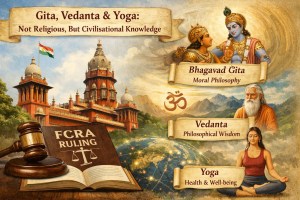
In a noteworthy judgment with legal, cultural, and constitutional ramifications, the Madras High Court held that teaching or promoting the Bhagavad Gita, Vedanta, and Yoga does not constitute religious activity under Indian law. As a result, such teaching cannot be used to deny or cancel foreign funding under the Foreign Contribution Regulation Act (FCRA).
The ruling is not merely technical — it addresses a deeper question: How should India’s philosophical and civilisational traditions be classified in a modern secular regulatory framework?
The FCRA Framework and the Core Legal Issue
The FCRA regulates foreign funding received by individuals and organizations in India. A central restriction is that foreign contributions cannot be used for religious propagation.
However, the law expressly allows foreign funding for:
- Education
- Academic research
- Cultural preservation
- Social welfare and development
The dispute before the Court was whether teaching classical Indian knowledge systems could be construed as religious propagation — thereby triggering FCRA restrictions.
The Court’s answer drew a clear conceptual boundary between religion as sectarian practice and civilisational knowledge as education and culture.
The Court’s Three Key Distinctions (Expanded)
- Bhagavad Gita: A Universal Text of Ethical Philosophy
The Court characterised the Gita as primarily a work of moral philosophy and existential reflection, rather than sectarian scripture.
Elaboration of Key Themes
- Dharma (Duty and Responsibility)
The Gita frames dharma not as ritual obligation but as ethical responsibility shaped by context, role, and conscience. It encourages individuals to act responsibly in public life, family roles, and professional duties — making its lessons relevant to civic ethics and leadership studies. - Self-Discipline and Inner Mastery
The text emphasises control over impulses, emotional balance, and clarity of thought. These teachings resonate with contemporary psychological frameworks dealing with resilience, mindfulness, and behavioural regulation. - Self-Realisation and Personal Growth
The Gita explores the nature of the self and the pursuit of self-knowledge. In educational settings, this aligns with philosophical inquiry into identity, purpose, and meaning. - Ethical Action (Karma Yoga)
The concept of acting without attachment to results promotes integrity, professionalism, and public service ethics — themes often discussed in management and leadership education.
👉 Court’s conclusion: Teaching the Gita in classrooms or workshops is moral and philosophical education, not religious preaching.
- Vedanta: Metaphysical Inquiry Comparable to Global Philosophy
Vedanta was classified as a philosophical tradition concerned with consciousness, reality, and knowledge, rather than ritual practice.
Elaboration of Key Concepts
- Consciousness as Fundamental Reality
Vedantic thought explores whether consciousness is primary to existence — a question echoed in contemporary philosophy of mind and neuroscience debates. - Nature of Reality (Brahman and Maya)
Vedanta’s examination of ultimate reality versus perceived reality parallels metaphysical discussions in Western philosophy, including idealism and phenomenology. - Self-Knowledge (Atman Inquiry)
The emphasis on introspective inquiry mirrors Socratic philosophy’s call for self-examination and modern existentialist thought. - Liberation Through Knowledge (Jnana)
Vedanta proposes that freedom comes through understanding, not ritual — reinforcing its philosophical rather than devotional orientation.
👉 Court’s conclusion: Vedanta is a knowledge system and philosophical discipline, comparable to global intellectual traditions.
- Yoga: A Scientific and Holistic Discipline
The Court recognized Yoga as a civilisational discipline integrating physical, psychological, and mental well-being.
Elaboration of Its Dimensions
- Physical Health and Preventive Medicine
Yoga’s postures and breathing practices are widely studied for improving flexibility, cardiovascular health, and chronic disease management. - Mental Discipline and Cognitive Clarity
Meditative practices enhance concentration, stress regulation, and emotional resilience — aligning with modern mental health approaches. - Psychological Well-being
Yoga-based interventions are increasingly used in anxiety, depression, and trauma recovery programs globally. - Holistic Lifestyle Framework
Beyond postures, Yoga integrates ethical conduct, diet, mindfulness, and self-awareness — making it a comprehensive wellness framework.
👉 Court’s conclusion: Teaching Yoga is educational, therapeutic, and cultural, not religious instruction.
Historical and Legal Context: How Indian Institutions Have Treated These Traditions
- Judicial Recognition of Yoga as Secular Practice
Indian courts have previously treated Yoga as a health and educational activity. Several High Court rulings have allowed Yoga instruction in schools, emphasizing its scientific and wellness benefits rather than religious character.
Additionally, global recognition — including the UN’s declaration of the International Day of Yoga — reinforced its secular wellness identity in policy discourse.
- Judicial Approach to Philosophical Texts
Indian constitutional jurisprudence has often distinguished philosophy from religion. Courts have recognized that ethical teachings from classical texts can be taught academically without violating secular principles, provided instruction avoids sectarian indoctrination.
- Government Policy and Cultural Institutions
Successive governments have promoted Yoga and Indian philosophy through:
- University departments of philosophy and Indology
- Cultural exchange programs
- AYUSH initiatives integrating Yoga into healthcare
- National and international Yoga missions
These initiatives consistently framed Yoga and classical philosophy as heritage, health, and knowledge systems rather than religious propagation.
Why the Judgment Matters Today
- Regulatory Clarity for Civil Society
Educational trusts, research institutes, and cultural organizations can now teach Indian philosophical traditions without fear of FCRA violations, provided their activities remain educational.
- Protecting Academic Freedom
The ruling safeguards universities and scholars engaging with classical Indian knowledge from regulatory misclassification.
- Cultural Diplomacy and Soft Power
By affirming the civilisational nature of these traditions, the judgment supports India’s global cultural outreach and knowledge exchange.
- Secularism Through Intellectual Pluralism
The judgment reflects a nuanced understanding of secularism — one that allows philosophical traditions to be studied academically without labeling them religious propagation.
Constitutional Significance
The ruling subtly reinforces constitutional principles by acknowledging that:
- India’s civilisational traditions predate modern religious categories
- Philosophy and spirituality can exist outside sectarian identity
- Cultural knowledge systems form part of national heritage
- Regulatory frameworks must respect intellectual and cultural pluralism
The Larger Intellectual Question
The judgment contributes to a broader debate in comparative constitutional law:
How should ancient civilisational knowledge systems be classified in modern secular states?
By distinguishing philosophy, culture, and wellness from religious propagation, the Court’s reasoning may influence future cases involving traditional knowledge, indigenous practices, and cultural education.
In One Sentence
The Madras High Court affirmed that the Gita, Vedanta, and Yoga are civilisational systems of ethical, philosophical, and scientific knowledge — not religious preaching — and therefore their teaching cannot be restricted under the FCRA.
